Open source technologies are so well suited to the charity industry, but with so many to choose from, it can be a huge task to undertake just to choose the right one for your charity website.
So, you’ve decided on Open Source … But, where next?
12/10/2022
Open source technologies are so well suited to the charity industry, but with so many to choose from, it can be a huge task to undertake just to choose the right one.

More often than not, the first question that gets asked at the beginning of a charity website project is ‘Which CMS should we use?’.
Not all charities have the same needs or requirements, and therefore, rather unfortunately, there isn’t an exact answer.
However, what we can say is that unless you are a charity that has a huge budget or very very niche requirements, you should immediately rule out a bespoke technology!
Open source technologies are so well suited to the charity industry, but with so many to choose from, it can be a huge task to undertake just to choose the right one.
In this blog post, we consider the four most popular open source technologies that we have identified from our research of reviewing UK charity websites. They are Drupal, Umbraco, Joomla and WordPress.
Is Drupal the one for you?
Drupal has come a very long way since its inception as ‘drop.org’ back in 2000.
Initially a messaging board software, its creators Dries Buyteart and Hans Snijder decided to release it as an open-source platform in 2001, renaming it Drupal, the English pronunciation of ‘Druppel’, meaning ‘drop’.
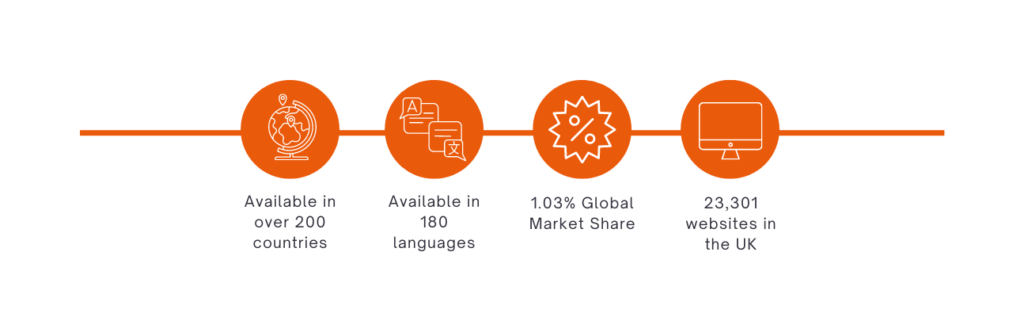
Nowadays, Drupal is present in over 200 countries, is available in over 180 languages, and boasts a Global Market Share of 1.03%, amounting to well over 23,000 websites in the UK alone!
And, some of the UK’s largest charities such as Anthony Nolan, Great Ormond Street and Battersea Cats and Dogs Home have all decided to build their websites on their platform.
So, here’s a quick rundown of some of the main advantages of using the platform:
- Huge community – Drupal boasts one of the largest open source communities in the world, with more than 1 million people involved with the platform, making support and assistance easy to find.
- Security – Unlike a lot of other platforms, Drupal doesn’t depend on third party plugins, making the platform less vulnerable to security risks.
- Commitment to accessibility – Drupal’s approach to providing an inclusive website experience to all is a key reason as to why it is often a platform considered by charities.
However, there are drawbacks to using the platform:
- Difficult to use – From our experience, Drupal isn’t the most user friendly platform available, which may prove a challenge without specialist developer assistance.
- Lack of modules – When compared to WordPress, Drupal has nowhere near the number of modules and features that can be used.
- Unsuited to the beginner – Drupal requires some understanding or basic knowledge of HTML, CSS and PHP, making it a steep learning curve for those new to the area of web management.
The flexibility of Drupal makes it suitable for a lot of projects.
However, unless your charity’s marketing team have used the platform previously or have a lot of time on their hands to learn its ins and outs, there may be other suitable alternatives.
Maybe it’s Umbraco?
Much like Drupal, Umbraco started its life in 2000.
Developed by Niels Hartvig, a self-taught software developer, it was released as open-source software some 4 years later in 2004.
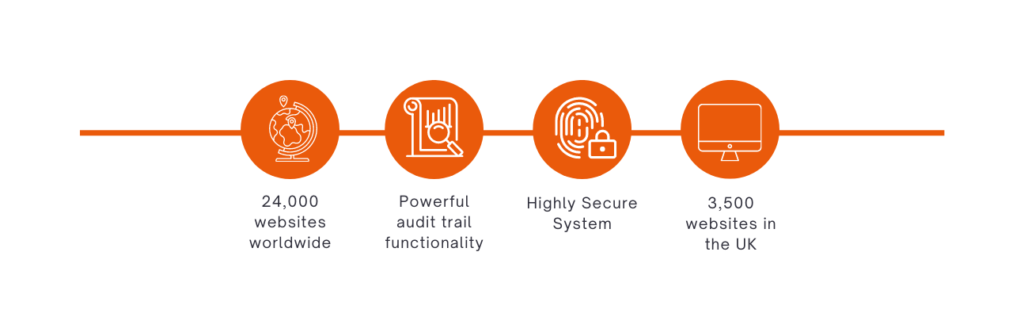
Used by UK charities such as Action for Children, YoungMinds and The Operational Research Society, Umbraco has more than 24,000 websites worldwide and over 3,500 in the UK.
But with the fastest decline in market share of all the CMS’ detailed in this blog, is Umbraco the right CMS for you?
Here are some pros of the Umbraco platform:
- Great security – Built with the Microsoft .NET framework, Umbraco benefits from a range of security features that other PHP-based CMS platforms do not.
- Powerful audit trail functionality – Comprehensive audit trails and rollback functionality are a welcome safety-net for if say, you accidentally delete a whole page of content… *gulp*
- Scheduled publishing – A great aid in advanced planning of content releases, or to un-publish time-sensitive content when it’s no longer relevant.
And here are some cons to consider:
- Developer resource needed – If you are looking to utilise Umbraco’s packages (basically Umbraco’s version of plugins), they’re largely coded, meaning you need a web developer to install or set them up.
- Difficult to use – Leading on from the above, much like Drupal, Umbraco is more suited for developers and designers, as opposed to an everyday website administrator. Unless that website administrator is skilled in C# coding language!
- Fewer hosting options – Hosting providers need to have Windows servers to host your website so you may find yourself limited to more expensive hosting options.
All things considered, Umbraco might be the right fit for your charity website.
If you’re taking donations via the website or you are holding sensitive data, you can surely benefit from its strong security.
But if you’re looking for something that’s a bit more beginner-friendly or intuitive, what are your other options?
Joomla then?
Launched in 2005, Joomla is estimated to be the fifth most used CMS on the internet after the likes of Shopify, Wix, Squarespace and WordPress.
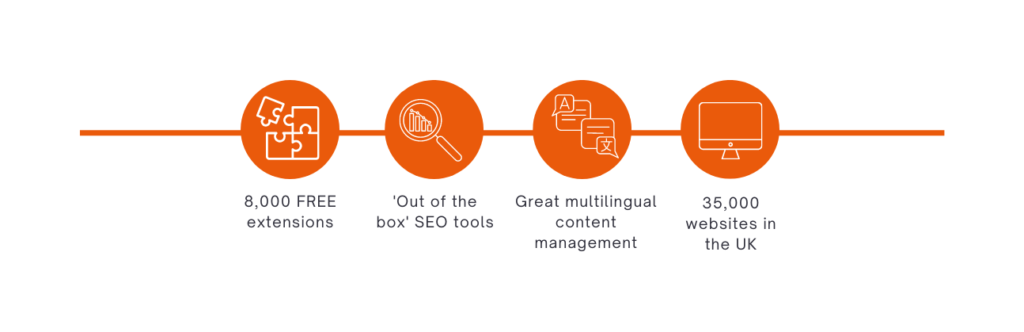
Accounting for over 35,000 websites in the UK alone and used by the likes of The National Council for Voluntary Organisations, Sea Shepherd and Institute Water for Africa.
Joomla has seen its place in the market decline in recent years, but this doesn’t mean Joomla has nothing to offer.
Let’s look at the benefits of the Joomla platform:
- ‘Out of the box’ SEO tools – Built and ready right out of the box are a number of SEO optimisation tools such as; metadata and keywords, extensive menu creation and robots settings for maximum ‘searchability’ of your content.
- Multilingual made easy – Joomla’s core product has more than 70 translation packs available for multilingual content management and translations. Perfect for websites who have a global reach.
- Advanced user management – Offers a more advanced system for user access controls and user management. Particularly useful for larger organisations with multiple staff members contributing to the website content.
And on the flip side, what’s not so good?:
- More knowledge required – Whilst there are undoubtedly some tasks that Joomla accomplishes much easier than its competitors, the everyday tasks, such as creating content, modifying site structure etc does take a certain level of expertise.
- Underwhelming number of extensions available – Joomla boasts a directory of around 8,000 free extensions, whereas Drupal has 42,000 and WordPress 54,000. Therefore, you’re more likely to have to resort to premium extensions (that come with a price) for more complex websites or functionality.
- Plugin compatibility issues – Plugin extensions can present compatibility issues with your site and require someone proficient in PHP to gain access to their full functionality, which could be costly if your site is constantly evolving to include more functions.
So irrespective of its decline in popularity, Joomla is still a viable player in the content management market as a full-scale solution for websites, big and small.
But let’s move on to our next CMS, drumroll please.
Aaahh … WordPress.
It’s no secret that as an agency we’re advocates of WordPress.
Originally created as a blog-publishing system in 2003, WordPress quickly evolved to support other web content types and subsequently became THE most popular content management system in the world.
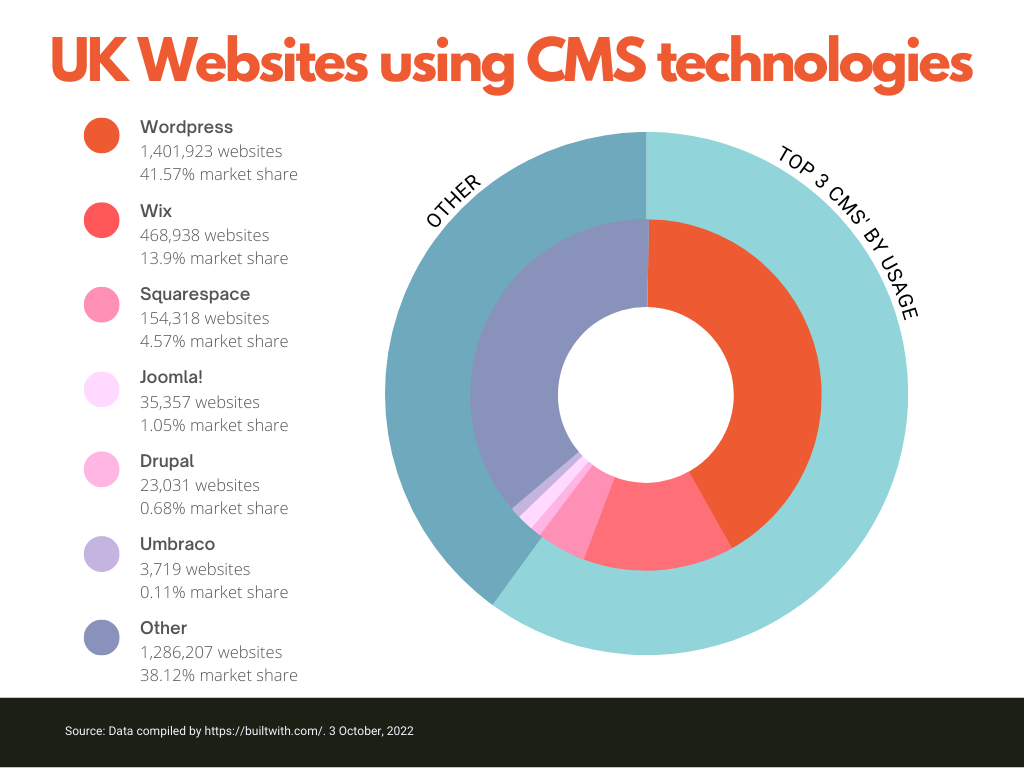
Worldwide however WordPress accounts for over 43% of websites in the world and is used by the likes of Unicef UK, Dementia UK and Greenpeace UK to power their web offering.
So let’s break it down. What are some of the good features of WordPress?:
- Intuitive user-friendly CMS – A WordPress website can be created and up-and-running in minutes, even without any technical expertise. It’s simple to use and organise website content, even without a lot of website management experience.
- Plugins to extend website functionality – There are thousands upon thousands of plugins available to WordPress users, allowing you to customise and evolve your site in a cost-effective manner.
- The WordPress community – WordPress has a vast community, ranging from freelance developers to digital agencies, making contributions to the platform regularly. Whether it be a new plugin, improvements to existing plugins or security updates to the WordPress source code, WordPress is an ever-growing, powerful hive of activity.
OK, OK, it wouldn’t be fair if we didn’t address some of the cons of the platform. We can’t play favourites can we?
- Updates are necessary – Keeping on top of WordPress updates is important for the health of your website to ensure that your site stays secure and up-to-date. Failure to keep on top of updates may open up a back door to hackers. We touched upon the importance of a WordPress update policy in a previous blog post.
- Choosing plugins wisely – Not adding reputable plugins may be detrimental to your website. Mitigating this risk however is easy, always assess the quality of the plugin you’re installing. Still not sure? Consult a web partner, or IT professional for assistance.
- Using a theme? Speed may be an issue – If you’re using a WordPress theme or template to build the site, you may find that website speed is an issue. Themes are often created with lots of code to try and be a one-size fits all solution to multiple organisations. A web partner can again help you decipher what code you can and cannot live without.
Lasting thoughts.
Ultimately, WordPress’ popularity worldwide tells you a lot about the platform. It’s a CMS that spans industries, accounting for the largest percentage of market share and is the most widely used CMS in the UK Charity Sector.
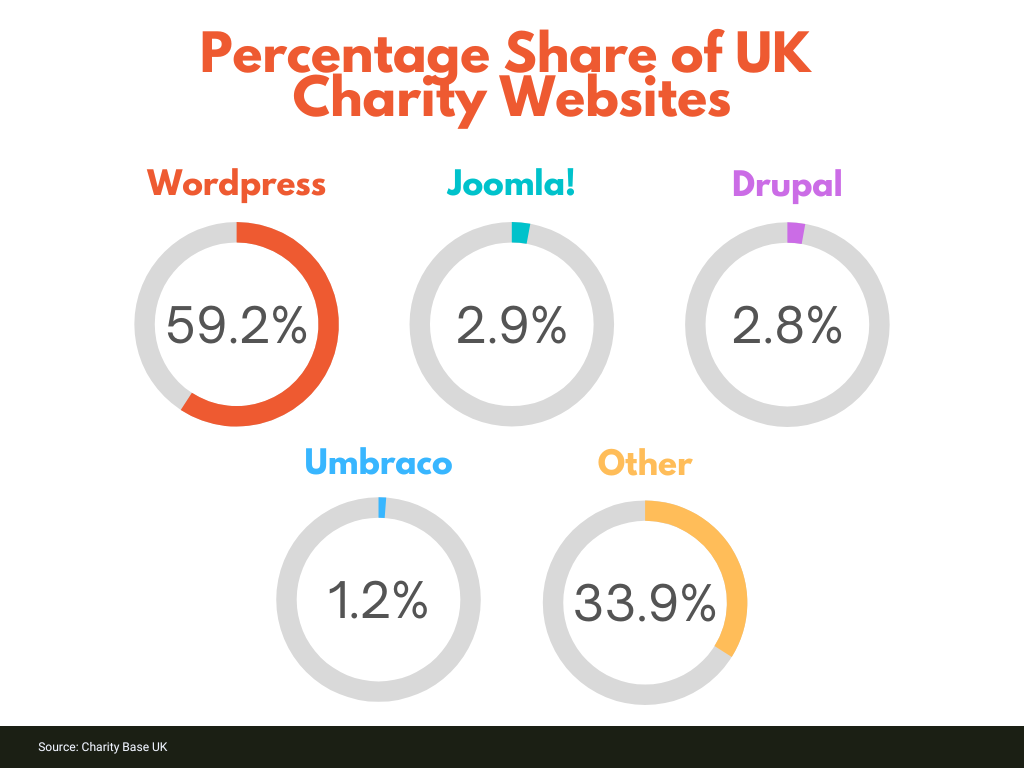
Its ease of use, scalability and modular framework makes it a great choice for charities big and small, whether it be a simple site created to raise awareness or a more complex donation platform – WordPress fits the bill.
We’re certainly one of its biggest fans, but that being said, it’s not the only option and the important thing is evaluating what platform works best for you and your organisation.
If you’re looking for more information on how WordPress can power your charity website, get in touch on 01474 704400 or by emailing [email protected].
Sources:
builtwith https://builtwith.com/
Charity Base UK https://charitybase.uk/